

1in1000 Model Suite
-
Our Transition Risk Model assesses the potential impact of future policy shocks on companies, with a focus on how these shocks could require firms to shift their production towards a Paris-aligned trajectory, helping investors to understand the financial implications of this transition.
-
Our physical risk model, currently under development, evaluates the impact of natural hazards on firm production outputs at the asset level. By taking into account geographic location, the model assesses potential risks associated with natural disasters such as droguths or hurricanes.
The Model provides financial institutions with valuable insights about the identification and potential impact of climate change related physical risks on their portfolio.
-
Our litigation risk model, currently under development, analyzes how climate-related litigation could affect specific firms' profitability ,by taking into account a firm’s historic and future misalignment to a Paris-aligned pathway
-
The model suite is perfectly placed to be expanded to incorporate scenarios on the deterioration of ecosystem services. For this, we would expand our model framework with the Ecosystem Services Valuation Database (ESVD) database to assess the dependency of asset-level production on natural capital such as land use, clean water supply and air. These quantitative data inputs can be mapped to the climate risk models and applied to financial portfolios based on the asset & SME data described above.
-
The model will focus on, first, a political risks related to political backlash of climate transition policies and the political costs & climate costs such backlash can engineer. This will involve a political simulation of various outcomes based on historical case studies of the cost of policy reversal and policy disruption. Second, the project will focus on economic risks related to the inability to retrain, reskill, and reapply people across industries. Here too, models will build on historical case studies of failed industrial transformations in Europe and internationally and the economic cost that such failures had at regional level. The approach will thus build on adjusting historical case studies as inputs into climate risk model frameworks. These shocks will then be mapped to financial portfolios based on the economic geography indicators from the asset-level & SME database that allows for granular regional mapping.
At the foundation of our analysis are five-year ahead forward-looking projections of production (2021-2026) for over 80,000 companies globally and eight sectors, covering the majority of global emissions. We've obtained this data through our strategic partner, Asset Resolution, which provides us with reliable and comprehensive information for our analysis. With this data, we're able to build a detailed understanding of the current and future production trajectories of companies, which is critical for assessing climate risks and opportunities.
Our model is suited to analyse the potential impacts of the five types of Climate related risks using different approaches.
Model Design (Transition Risk)
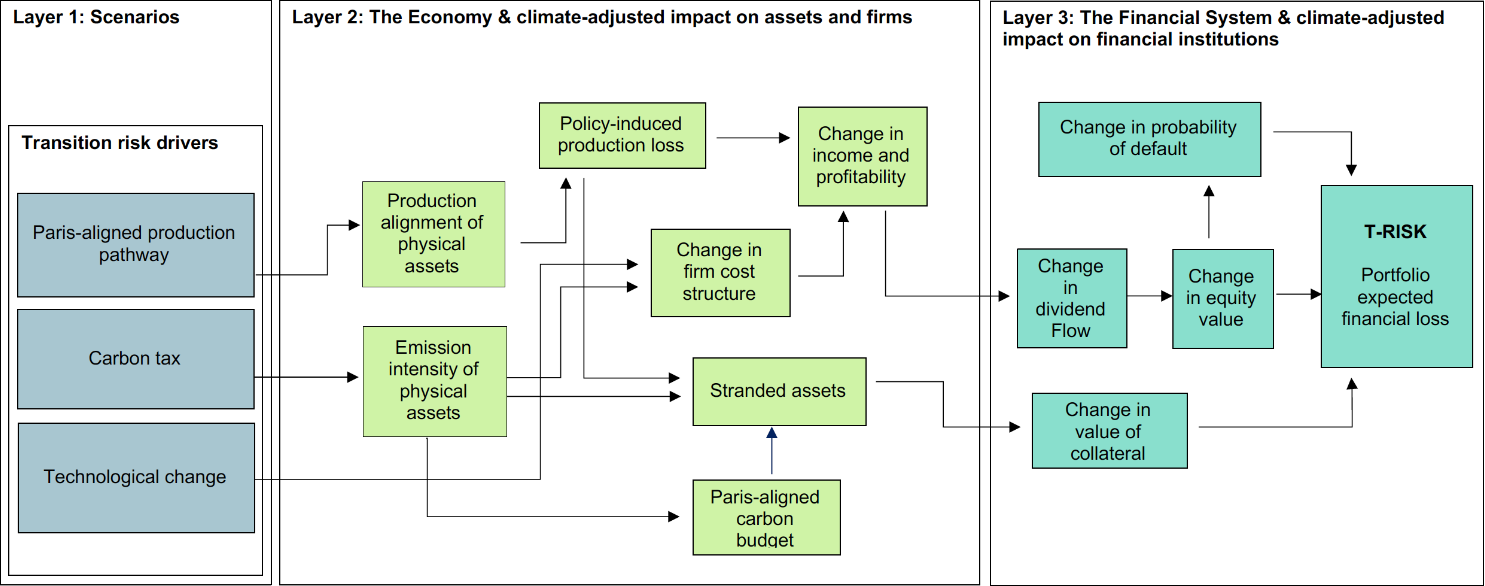
Scenarios: This layer represents the source of transition risk and is made up of a set of climate-adjusted economic parameters curated from a range of severe but plausible transition scenarios. Currently, we're working with scenarios from reputable sources such as the International Energy Agency (IEA), the Network for Greening the Financial System (NGFS), and the UN PRI Inevitable Policy Response (IPR) scenarios.
Economy: This layer describes the real economy and individual firms' asset values under different scenarios. We represent each firm by its physical economic assets and associated ownership structure, allowing us to model the impacts of transition risks on specific companies and industries.
Financial System: The final layer describes the financial system and is represented by heterogeneous financial institutions and their balance sheets. By understanding the potential impacts of transition risks on the financial system, we can assess the systemic risks associated with a transition to a low-carbon economy.
Together, these three layers provide a comprehensive approach to stress testing and allow us to assess the potential impacts of transition risks on the real economy and financial system.
Our Stress Test Model consists of three interlinked layers designed to assess transition risk and the potential impacts on the real economy and financial system.
Model Process
Our transition scenarios consider decarbonisation pathways and technological advancements that influence the unit price and cost of various technologies (e.g. solar, oil extraction, and electricity generated from coal-fired power plants).
Our climate-adjusted economic parameters affect the physical production of firms, resulting in additional costs and market share shifts depending on the Paris alignment of firms.
This impacts firms' cost structure and production mix across technologies and business units, which, in turn, affects their income and profitability.
We then translate the impacts on firms into changes in equity valuation through a discounted dividend flow model.
Lastly, we use a time-horizon adjusted Merton credit risk framework to convert the equity impacts into changes in the probability of default.
Our model is able to show potential changes in Equity valuation and probability of default that can result through a one time climate change related global policy shift.